
LMN-Tool: Matlab-Toolbox for Local Model Networks
Download Matab Source Code (Version 1.5.2.1) (Non-Commercial Use only, see included licence file)

This work is licensed under a Creative Commons Attribution-NonCommercial-ShareAlike 4.0 International License.
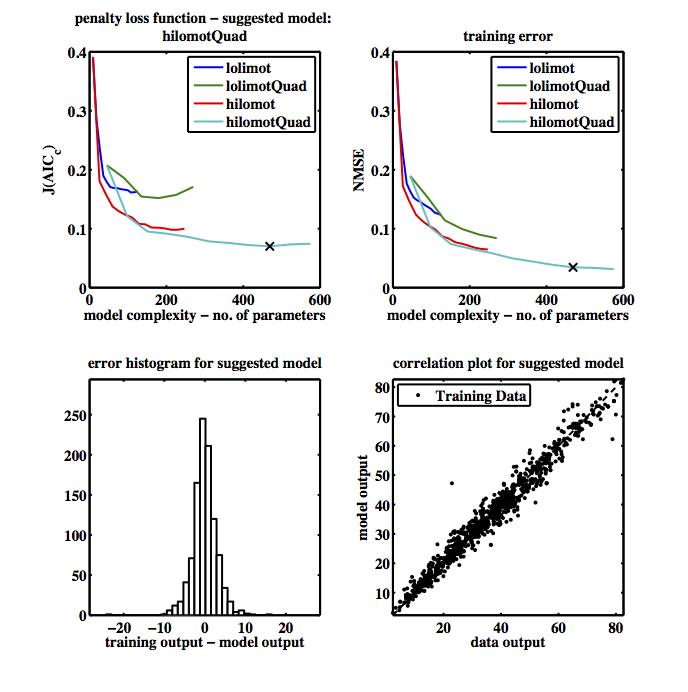
This object-oriented Matlab toolbox covers two algorithms for building local model networks (also called Takagi-Sugeno fuzzy systems) from data:
LOLIMOT (LOcal LInear MOdel tree)
- Axes-orthogonal partitioning into hyper-rectangles
- Normalized Gaussian validity functions
- Orthogonal splits in ratio 1:1 are tested
HILOMOT (HIerarchical LOcal MOdel Tree)
- Axes-oblique partitioning into arbitrary shapes
- Sigmoidal validity functions constructed hierarchically
- Oblique splits in optimized ratio and direction
- Split optimization is a separable nonlinear least squares problem
- Outer loop: Constrained nonlinear split optimizations
- Inner loop: Local weighted least squares estimation of local model parameters
These are the key features of local model networks as applied here:
- Tree-construction builds an incrementally growing network
- Separation between inputs/variables that
- influence the nonlinear behavior (premise space z)
- influence the local (linear) models (consequents space x)
- Local models are estimated locally with weighted least squares
- Locally worst model is split
- Good interpretability
- Possibility to transfer/adapt solutions for linear problems to the nonlinear world
- Adaption of the model in specific regions unproblematic (no unlearning!)
→ only in regions with fresh data the model behavior is adjusted
These are the key features of this toolbox:
- Object-oriented implementation with classes
- Reasonable default values allow simple usage: LMNTrain(data)
- Individual setting can be assigned by changing the class properties
- Termination criterion of tree-construction is a 2x increasing AICC (default)
- Dynamic models are possible with arbitrary delays for inputs and outputs
- Splitting can be performed according to the output/simulation error
- Local models are polynomials of arbitrary degree (default is 1 and 2)
- Training, validation (optional), and testing (optional) data can be used
- Splitting smoothness is set to a reasonable default value
If you want to publish your results generated with this toolbox, please acknowledge our work by citing the following article:
Hartmann B., Ebert T., Fischer T., Belz J., Kampmann G., Nelles O.: "LMNtool - Toolbox zum automatischen Trainieren lokaler Modellnetze", 22. Workshop Computational Intelligence, Dortmund, Dezember 2012.
Keywords: Local model network, Takagi-Sugeno fuzzy system, neural network, neuro-fuzzy, LOLIMOT, HILOMOT, machine learning, nonlinear system identification, nonlinear dynamic model, local regression, least squares, tree-construction, Gaussian, sigmoid, normalized, hierarchical